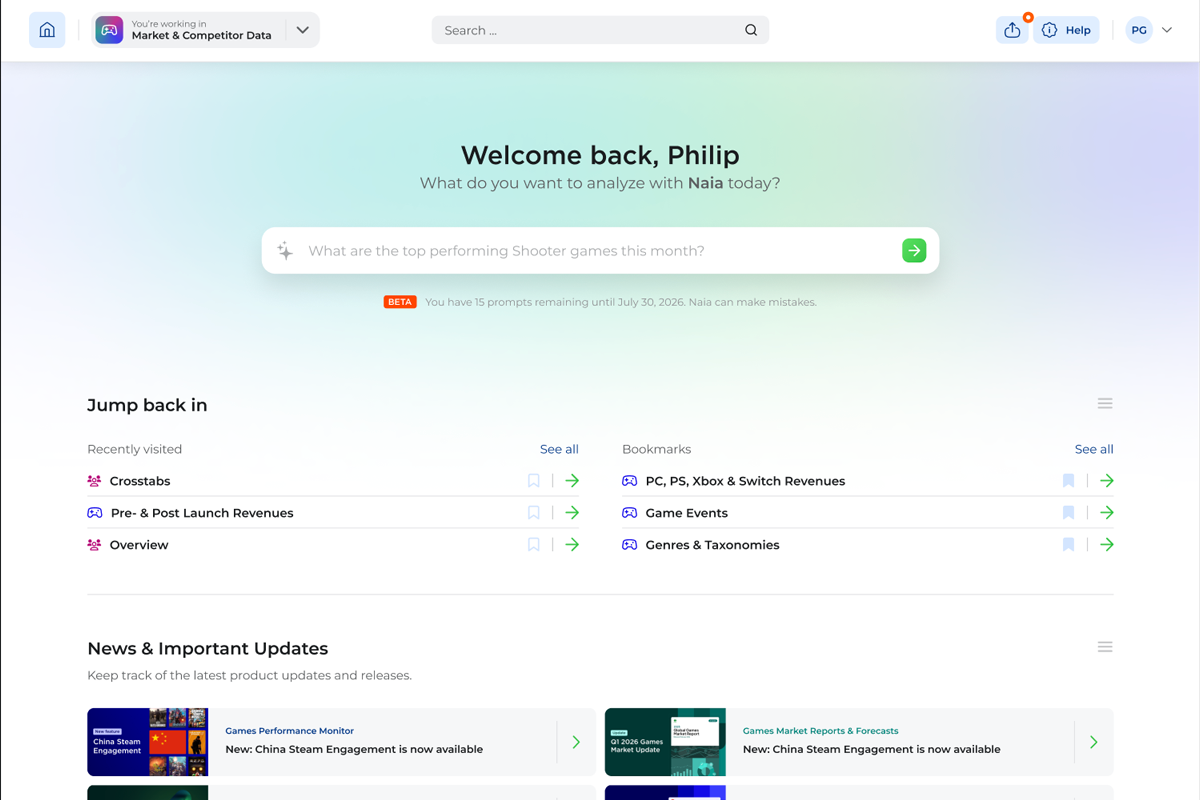

01 · The core question
Can Naia increase client value and retention more than it increases AI usage cost?
For the pilot, the goal is not to get pricing perfect from day one. The goal is to learn how clients use the assistant, what value they attach to it, and which commercial setup feels fair to both Newzoo and customers.
02 · Why this matters
Naia changes the way clients access Newzoo data.
Faster time-to-insight
Clients can ask direct business questions instead of navigating multiple dashboards, reports, filters and exports.
Higher perceived value
The same data becomes more accessible to more users inside the client organization.
Stronger differentiation
Newzoo moves from static data access to an answer layer on top of proprietary games intelligence.
03 · Commercial tension
The value is clear, but the economics are different.
Current Newzoo model
Clients are used to fixed annual subscriptions for products and datasets.
Naia model pressure
Each answer can carry real cost, depending on retrieval, context, reasoning depth and model usage.
04 · Business risks
What we need to avoid.
“Paying twice” perception
Clients already license the data and may resist paying again just to retrieve it differently.
Cost unpredictability
Usage-based pricing may clash with enterprise procurement and annual budget expectations.
Margin leakage
Heavy use by a small number of accounts could create meaningful, uncapped AI costs.
Cannibalization
If positioned poorly, Naia could make current products feel less necessary rather than more valuable.
05 · Recommended pilot approach
Start with included usage, measure everything, and test willingness to pay later.
Commercial setup for pilot
- Invite a small set of trusted clients.
- Include Naia at no extra cost during the pilot.
- Set a soft monthly usage allowance per account.
- Do not bill overages yet, but make usage visible internally.
06 · Pricing models to test
The likely answer is not pay-per-prompt.
| Model | Client experience | Newzoo upside | Recommendation |
|---|---|---|---|
| Included credits Monthly or annual allowance |
Predictable, feels fair | Controls cost and supports expansion | Test first |
| Tiered access Higher limits in premium tiers |
Fits existing packaging | Supports upsell motion | Promising |
| Credit packs Buy more when needed |
Flexible but slightly transactional | Recovers cost from heavy users | Use as overage |
| Pure pay-per-prompt | Unpredictable and may discourage use | Direct cost recovery | Avoid as default |
07 · Packaging direction
Make Naia feel like a subscription enhancement, not a meter.
Included with eligible data products
A meaningful monthly allowance for clients who already license the relevant datasets.
Higher AI limits in premium tiers
Use Naia to support enterprise upgrades, more seats, broader data coverage and renewal conversations.
Fair-use and overage bundles
Protect margin without making every question feel expensive or risky to the user.
08 · What we need from Commercial & Account Management
This pilot should be a feedback engine.
Questions to validate with clients
- Which workflows does Naia improve most?
- Does it make the existing subscription feel more valuable?
- What usage level feels “included” and fair?
- What pricing would create pushback?
- Would Naia influence renewal or expansion?
09 · Six-month learning plan
Use the runway to de-risk value, adoption and margin.
10 · Success metrics
What would make this worth scaling?
Product & client value
- Repeat weekly usage by pilot accounts
- High satisfaction with answer quality and sources
- Clear examples of time saved or better decisions
- Usage across multiple user types, not only power users
Commercial viability
- Cost per account remains within acceptable guardrails
- Commercial teams see renewal or expansion potential
- Clients accept included credits / fair-use framing
- No strong evidence of product cannibalization
11 · Decision after pilot
The likely commercial path.
If the pilot validates value, Naia should launch as a premium AI layer with included usage tied to subscription size, plus clear expansion paths for higher-volume clients.
12 · Discussion
What we need feedback on now.
Client selection
Which accounts are best suited for a constructive pilot?
Commercial framing
Which wording will feel fair to clients that already pay for Newzoo data?
Packaging risk
Where do you expect the strongest pushback from buyers, users or procurement?
Naia · The decision
Can Naia increase client value and retention more than it increases AI usage cost?
We want to test this without repricing everything on day one — and without walking into four known traps.
“Paying twice”
Clients already license the data and may resist paying again just to retrieve it differently.
Cost unpredictability
Usage-based cost clashes with annual budgets and enterprise procurement.
Margin leakage
A few heavy accounts could create meaningful, uncapped AI cost.
Cannibalization
Positioned poorly, Naia could make current products feel less necessary.
So here's the real question we're trying to answer with Naia — can it grow how much clients value us and stay with us, faster than it grows our AI costs? That's the whole game.
And notice what we're not saying: we're not trying to reprice everything overnight. We just want to learn.
The reason we're being careful is there are four traps we already know are out there. First, the “paying twice” feeling — clients already license this data, so asking them to pay again just to ask a question can rub the wrong way. Second, cost that's hard to predict — our costs move with usage, but client budgets are annual and fixed. Third, margin leakage — a handful of heavy users could quietly rack up real cost. And fourth, cannibalization — position this badly and Naia makes our existing products feel less essential instead of more. Keep those four in mind, because everything after this is about avoiding them.
Naia · How we might sell it & how we'll learn
Commercial models to test — and a small, controlled beta.
Commercial models on the table
- Included credits — monthly/annual allowance. Predictable, feels fair. Test first
- Tiered access — higher limits in premium tiers. Fits packaging & upsell. Promising
- Credit packs — buy more when needed. Best as overage. Overage
- Pay-per-prompt — direct cost recovery, but unpredictable. Avoid as default
The roadmap is simple
We run a beta phase with a couple of hand-picked clients who give us direct feedback.
- Include Naia at no extra cost during the beta.
- Soft monthly usage allowance; usage visible internally.
- Learn value, adoption and real cost per account before we price.
So how might we actually sell this — and how do we figure it out without just guessing? On the left are the commercial models on the table.
Included credits — a set allowance each month or year — is our first pick to test, because it feels fair and it's predictable. Tiered access, where premium tiers get higher limits, is promising too and fits nicely with how we already package and upsell. Credit packs are useful, but more as a top-up for heavy users than a main model. And pure pay-per-prompt we'd rather avoid as a default — it just makes every question feel like it costs money.
Now, the plan to learn all this is deliberately simple. We run a beta with a couple of hand-picked clients who'll give us honest feedback. Naia's included at no cost during the beta, we set a soft usage allowance and watch it internally, and we learn what people actually value and what it really costs per account — before we put a price on anything. The goal isn't perfect pricing on day one; it's understanding what's fair to both sides.
Naia · Questions worth sitting with
The open questions we'll explore together.
None of this needs an answer today. These are the questions the beta is designed to help us work through as a group — across product, data and how we eventually take Naia to market.
Where does it create most value?
Which workflows and users does Naia genuinely make faster or better?
What feels fair to charge for?
How much usage should feel “included”, and which model sits comfortably alongside what clients already pay?
Where might clients hesitate?
Which framing or pricing could create friction — and how do we get ahead of it?
And that brings us to the questions worth sitting with — as a group. None of these need an answer today, so please don't feel put on the spot.
These are just the things the beta is designed to help us work through together — across product, data, and how we eventually take Naia to market. Where does it create the most value: which workflows, and which people, does it genuinely make better? What feels fair to charge for: how much should feel “included”, and which model sits comfortably next to what clients already pay us? And where might clients hesitate: what framing or pricing could cause friction, and how do we get ahead of it?
No decisions here — just worth keeping these in the back of your mind as the beta plays out, because that's exactly where the real answers are going to come from.